
Research Contribution DOI:10.56994/ARMJ.012.00?.00?
Received: 12 Jul 2025; Accepted: 5 Sep 2025


Anti-classification for flows on two-tori

Nataliya Goncharuk Texas A&M University, College Station, TX, USA
natasha_goncharuk@tamu.edu
ORCID 0000-0002-4270-0510
MCS 37E35, 54H05, 03E15
Keywords: Borel equivalence relations, Borel hierarchy, low-dimensional dynamics, rotation numbers
Abstact.
We prove that the classification of real-analytic vector fields on the two-torus up to orbital topological equivalence does not admit a complete numerical invariant that is a Borel function. Moreover, smooth vector fields that are difficult to classify appear in generic smooth 7-parameter families. In dimension 2, this improves the recent result of A. Gorodetski and M. Foreman [6] for non-classifiability of smooth diffeomorphisms up to continuous conjugacy.

1 Introduction

Classification results constitute one of the central parts of the modern theory of dynamical systems. For example, due to Denjoy theorem, rotation number is a complete invariant that classifies C2-smooth circle diffeomorphisms f:// without periodic orbits up to continuous conjugacy. Separatrix skeletons, graphs, or schemes are used to classify planar vector fields up to orbital topological equivalence. Ornstein’s theorem [14] states that entropy is a complete invariant that classifies, up to measure-preserving transformation, Bernoulli shifts on closed subsets of the space of bi-infinite sequences.

On the other hand, Yoccoz’s example shows that rotation number cannot be used to classify circle diffeomorphisms up to smooth conjugacy in the case when the rotation number is Liouville. P. Kunde showed [13] that smooth conjugacy on the space of circle diffeomorphisms admits no complete numerical invariant that is a Borel function. This is an anti-classification result that captures the complicated nature of the equivalence relation.

Strong anti-classification results were obtained in ergodic theory. Consider the space X of C-smooth diffeomorphisms of a torus. Let the equivalence relation be a measure-preserving conjugacy. In [8], M. Foreman and B. Weiss proved that this equivalence relation is not Borel: the set {(S,T)X×XST} is not Borel with respect to the C-topology in X×X. Earlier in [7], M. Foreman, D. Rudolph, and B. Weiss proved that measure-isomorphism for measure-preserving ergodic maps on the interval is not a Borel equivalence relation. In [9], M. Gerber and P. Kunde proved that Kakutani equivalence relation for ergodic measure-preserving transformations is also not Borel.

In Sec. 2, we will introduce Borel reducibility, the partial order on equivalence relations that produces the hierarchy of equivalence relations (see also [5]). For many natural equivalence relations, their place in this hierarchy is not known. An important breakthrough was a paper by M. Sabok [15] who showed that the isomorphism of separable C algebras is the maximal equivalence relation among all orbit equivalence relations. J. Zielinski [16] showed that the homeomorphism of compact metric spaces is also maximal among all orbit equivalence relations. It is an open question whether measure-isomorphism for measure-preserving ergodic maps has the same property.

One of the natural equivalence relations in dynamical systems theory is continuous conjugacy. In the space of diffeomorphisms, A. Gorodetski and M. Foreman [6] showed that this equivalence relation for smooth diffeomorphisms of 2 has no complete Borel numerical invariants. Moreover, for diffeomorphisms on 5, this equivalence relation is not Borel111 In [6], authors announced stronger results, but they were not published as of 07/2025.. However, proofs involve classification of diffeomorphisms that are highly degenerate. Related results were obtained in the space of continuous interval maps and circle maps, see [1] and references therein.

Planar vector fields can be classified up to orbital topological equivalence using a combinatorial invariant (in the form of separatrix skeletons, schemes, or Leontovich-Mayer-Fedorov graphs). Classification of vector fields on the torus is more complicated: since circle maps can appear as Poincare maps, classification invariant should incorporate both the information about the behavior of separatrices and the rotation number of the Poincare map. We will see that this is sufficient to obtain non-classifiability results similar to [6, Theorem 2].

The proofs are not directly related to, but largely inspired by, new examples in the modern bifurcation theory for planar vector fields that arise from sparkling separatrix connections, see [12].

Let 𝒱2(T2) be the space of C2-smooth vector fields on the two-torus T2=2/2. Let 𝒱ω(T2) be the space of real-analytic vector fields on the two-torus.

Definition 1.

Two vector fields v,w𝒱2(T2) are orbitally topologically equivalent, vw, if there exists a homeomorphism H:T2T2 that is homotopic to identity, such that H takes orbits of v to orbits of w, preserving time orientation.

The main results of the paper are the following.

Theorem 2.

Orbital topological equivalence in 𝒱2(T2) has no complete Borel numerical invariant: there is no Borel function g:𝒱2(T2)Y with Y a Polish space such that for all v,wX, we have vw if and only if g(v)=g(w).

Theorem 3.

Orbital topological equivalence in 𝒱ω(T2) has no complete Borel numerical invariant: there is no Borel function g:𝒱ω(T2)Y with Y a Polish space such that for all v,wX, we have vw if and only if g(v)=g(w).

By a classical Kuratowski’s theorem, all uncountable Polish spaces are Borel isomorphic. In particular, any Polish space Y is Borel isomorphic to , thus we refer to these statements as the absence of numerical invariants for orbital topological equivalence. Results also imply that there are no complete functional invariants in any Polish functional space.

Below we will formulate and prove a stronger version of Theorem 2: vector fields that are difficult to classify appear in a generic 7-parameter family, see Theorem 14.

Remark 4.

While circle diffeomorphisms appear as first-return maps for vector fields on the torus, result of [13] does not imply Theorem 2, since we consider a different equivalence relation.

Remark 5.

While time-1 flows of vector fields v𝒱(T2) are diffeomorphisms of T2, continuous conjugacy for resulting diffeomorphisms does not coincide as equivalence relation to orbital topological equivalence of corresponding vector fields. So Theorem 2 does not imply [6, Theorem 2]. However, equivalence of vector fields is considered to be much simpler than equivalence of planar diffeomorphisms (e.g. Newhouse phenomenon does not happen for flows of vector fields). So in a sense, our result is stronger than [6, Theorem 2]. Also, methods of [6] do not allow analytic diffeomorphisms, in contrast with Theorem 3.

Recall that an equivalence relation on a set X is not Borel if the set {(S,T)X×XST} is not Borel. Even though equivalence relations in Theorems 2, 3 do not admit Borel numerical invariants, it is likely that they are Borel. We already cited results [8],[7], [9] on non-Borel equivalence relations that naturally appear in dynamics. In particular, [6, Theorem 1] states that continuous conjugacy defines a non-Borel equivalence relation on diffeomorphisms of 5. The following questions are open.

Can we find a two-dimensional manifold M such that the orbital topological equivalence of Cω vector fields on M is not Borel?

Can we find a generic finite-parameter family of vector fields vρ, ρk on a two-dimensional manifold such that the orbital topological equivalence is not Borel: the graph {(ρ1,ρ2)2kvρ1vρ2} of the orbital topological equivalence relation on this family is not a Borel set?

We refer the reader to [2] for the list of open questions in descriptive set theory related to dynamical systems.
2 Preliminaries: Borel reduction

We refer the reader to [5] for an expository introduction to Borel reduction and the hierarchy of equivalence relations with respect to the Borel reduction.

Recall that a topological space X is called Polish if it is separable and completely metrizable (i.e. admits a complete metric that is compatible with the topology). The σ-algebra of Borel sets of X is the smallest σ-algebra containing all open sets. A map f:XY between two topological spaces is called Borel if for any open set A, f1(A) is a Borel set.

Consider an equivalence relation on the set X. We write xEy if x,y are equivalent with respect to E.

Definition 6.

An equivalence relation E on X is smooth if there exists a Polish space Y and a Borel function f:XY such that xEy holds if and only if f(x)=f(y) for all x,yX.

Theorem 2 means that orbital topological equivalence of vector fields is non-smooth.

We will use the following non-smooth equivalence relation.

Definition 7.

Let Eα be the equivalence relation on the circle / given by xEαy if x=y+nαmod1.

The following proposition is the particular case of the general result (see [11, Theorem 1.1]): an equivalence relation that admits a non-atomic ergodic measure is not smooth. This statement is a part of the Glimm-Effros dichotomy, first discovered in [10], [4] for group actions. (Here, a finite Borel measure on X is called ergodic with respect to an equivalence relation E if any measurable E-invariant set has zero or full measure; a measure is called non-atomic if the measure of each E-equivalence class is zero.) For completeness, we will give an elementary proof of the proposition below.

Proposition 8.

For any α, for any nonempty open interval I/, Eα is a non-smooth equivalence relation both on I and on I{nα}n.

Proof.

Let Rα(x)=x+α be a rotation on a circle /. If there is a Borel numerical invariant f:I for Eα, then the sets Ay=f1((,y))I must be Borel, and thus Lebesgue measurable. Since every set Ay is an intersection of Rα-invariant measurable set with I, and Rα is ergodic, the measure of each set Ay is equal to 0 or to μ(I). Let x be the supremum of the set {y,μ(Ay)=μ(I)}. Since μ(An)=μ()=0 and μ(An)=μ(I), x is a finite real number. Then μ(f1((,x+1/n))=μ(I) for any n and thus μ(f1((,x])=μ(I). On the other hand, μ(f1((,x1/n))=0 for any n and thus μ(f1((,x))=0. We conclude that f1(x) has measure μ(I). This is impossible since f1(x) is the intersection of a single orbit of an irrational rotation with I and has measure 0. The proof for I{nα}n is analogous. ∎

Our main tool is a Borel reduction for equivalence relations.

Definition 9.

Let EX×X and FY×Y be equivalence relations on Polish spaces X and Y, respectively. A Borel function f:XY is called a Borel reduction of E to F if for all x1, x2X, we have that x1Ex2 if and only if f(x1)Ff(x2).

We say that E is Borel reducible to F, and write EBF.

Informally, if E is Borel reducible to F, then F is “not less complicated” than E. In particular, an equivalence relation E is smooth if and only if EB=, where = is the equality relation on .

Borel reducibility is a partial order; hence if E1BE2 and E1 is non-smooth, then E2 is also non-smooth (otherwise E1BE2B=). We conclude that Theorem 2 is implied by the following.

Theorem 10.

For each irrational number ϕ, there exists a smooth family of vector fields vρ,ϕ𝒱2(T2), ρ/, such that the equivalence relation Eϕ on (/){nϕ}n is Borel reducible to orbital topological equivalence: for ρ1,ρ2(/){nϕ}n, we have vρ1,ϕvρ2,ϕ if and only if ρ1=ρ2modnϕ.

This theorem is proved in the next three sections.

3 Construction of the family vρ,ϕ.

Recall that we consider vector fields on the two-torus T2=(/)2. Let Ms=/×{s} be the meridians of the torus. Fix ϕ[0,1] and ρ/.

Figure 1: Phase curves of the vector field vρ,ϕ.

We define vρ,ϕ in the following way.

  • On neighborhoods of M0 and M0.5, define vρ,ϕ=(ϕ,1).

  • Let the vector field vρ,ϕ in {0<y<0.5} have two saddles s1,S1.

    One stable separatrix γ1 of s1 intersects M0 at (0,0), two unstable separatrices of s1 form separatrix connections with two stable separatrices of S1, an unstable separatrix Γ1 of S1 intersects M0.5 at (ϕ/2,1/2). Let U1 be bounded by the separatrix connections; in U1, the vector field vr,ϕ has one stable and one unstable node.

    The correspondence map along vr,ϕ between the sides of R1 is given by (x,0)(x+ϕ/2,1/2), except it is undefined at (0,0).

  • For ρ=0, the vector field v0,ϕ in the domain {0.5<y<1} has a similar structure, with saddles s2,S2 and separatrices γ2,Γ2 that intersect M0.5 and M1 at (ϕ/2,1/2) and (ϕ,1) respectively. The only difference is, that in the domain U2 bounded by its separatrix connections, the vector field vρ,ϕ has one stable node and one unstable limit cycle with a stable node in it.

  • For other values of ρ, in the domain {0.5<y<1}, we put vρ,ϕ(x,y)=v0,ϕ(xρ,y).

With this definition, ρvρ,ϕ is a smooth family of vector fields for any fixed ϕ. The Poincare map under vρ,ϕ from the meridian M0 of the torus to itself coincides with xx+ϕ everywhere, except it is undefined at the intersections with γ1,γ2. If ρ{nϕ}n, then Γ2 does not coincide with γ1 and Γ1 does not coincide with γ2. In this case, we have M0γ1={nϕ}n=0 and M0γ2={ρnϕ}n=0.

Recall that if a point a is non-singular for a vector field, v(a)0, then there exists a neighborhood U with a smooth chart H:U2 such that Hv=(1,0). A continuous curve γ is topologically transverse to the vector field if it does not pass through singular points, and for any point aγ there exists its neighborhood U such that the image H(γU) is a graph of a continuous function x=x(y). The next lemma follows from elementary properties of correspondence maps.

Lemma 11.

For any simple closed loop αT2 homotopic to the meridian M0 that does not intersect U¯1U¯2 and is topologically transverse to vρ,ϕ, there exists a homeomorphism ξ:αM0 with the following property: if ξ(p1)=p2, then either p1,p2 belong to the same trajectory of vρ,ϕ, or p1Γ1Γ2 and p2γ1γ2.

Proof.

Lift vρ,ϕ to the vector field v^ on the cylinder /×. Lift α and M0 to the cylinder /× so that the lifts α^, M^0={y=0} do not intersect and α^ is above M^0. Then the correspondence map ξ^:α^M^0 along trajectories of v^ is well-defined. Indeed, since both curves are topologically transverse to v^, the only obstructions for extending the correspondence map are intersections of M^0 with stable separatrices of v^ and intersections of α^ with unstable separatrices of v^. Since M^0 and α^ do not intersect U¯1,U¯2, these are the intersections of the lifts of γ1,2 with M^0, and of the lifts of Γ1,2 with α^. Correspondence map ξ^ extends continuously to these intersections. It descends to the map ξ:αM0 that satisfies assumptions of the lemma. ∎

4 Equivalent vector fields have Eϕ-equivalent parameters

Lemma 12.

For irrational ϕ, let vρ,ϕ be vector fields constructed above. Suppose that ρ1,ρ2{nϕ}n.

If vector fields vρ1,ϕ1,vρ2,ϕ2 are orbitally topologically equivalent, then ϕ1=ϕ2 and ρ1=ρ2+nϕmod1.

Proof.

Let s1,2,S1,2,γ1,2,Γ1,2,U1,2 be as defined above for vρ1,ϕ1, and let s~1,2,S~1,2,γ~1,2,Γ~1,2,U~1,2 be analogous objects for vρ2,ϕ2.

Suppose that H is an orbital topological equivalence between vρ1,ϕ1 and vρ2,ϕ2. Since H takes attractors and repellors of vρ1 to attractors and repellors of vρ2 respectively, and limit cycles to limit cycles, we have H(U1)=U~1 and H(U2)=U~2; H(s1,2)=s~1,2 and H(S1,2)=S~1,2; therefore H(γ1)=γ~1 and H(γ2)=γ~2. (Here we used that phase portraits of vρ,ϕ|U1 and vρ,ϕ|U2 are different, otherwise H could map γ1 to γ~2 and γ2 to γ~1.)

The curve H(M0) is topologically transverse to vρ2, does not intersect U~1U~2 and is homotopic to M0, since H is homotopic to identity. Using Lemma 11, define a homeomorphism ξ:H(M0)M0 along trajectories of vρ2,ϕ2. We get an orientation-preserving circle homeomorphism ξH:M0M0.

Recall that the Poincare maps on M0 under the action of vρ1,ϕ1 and vρ2,ϕ2 equal xx+ϕ1, xx+ϕ2 respectively. Since ξH conjugates these Poincare maps, we have ϕ1=ϕ2. From now on, we will omit subscripts 1, 2 in the notation ϕ1,ϕ2.

Consider the set A1=(M0γ1)={nϕ}n×{0}. The set H(A1) belongs to H(M0)γ~1. Since ρ2{nϕ}n, the separatrix γ~1 does not form a separatrix connection with Γ~1,2; Lemma 11 implies that the set ξ(H(A1))M0 belongs to γ~1 as well.

Hence the circle homeomorphism ξH takes the dense set A1={nϕ}n×{0} into a subset of {nϕ}n×{0}. We conclude that ξH must be a rotation by kϕ, k.

On the other hand, analogous arguments for γ2 imply that ξH takes M0γ2={ρ1nϕ}n×{0} into a subset of M0γ~2={ρ2nϕ}n×{0}, hence ξH must be a rotation by ρ2ρ1+lϕ, l. We conclude that ρ2ρ1=mϕmod1. ∎

5 Vector fields with Eϕ-equivalent parameters are equivalent

Lemma 13.

For irrational ϕ, let vρ,ϕ be the vector field constructed above. Suppose that ρ1,ρ2{kϕ}k, and ρ1=ρ2+nϕmod1 for some integer n. Then vρ1,ϕ and vρ2,ϕ are orbitally topologically equivalent.

Proof.

We will write vρ instead of vρ,ϕ for brevity. Let ε be small so that the intervals

Ik=[ρ2+kϕε,ρ2+kϕ+ε]=[ρ1(nk)ϕε,ρ1(nk)ϕ+ε]

do not intersect for k=0,1,,n and do not intersect J=[ε,ε].

Let vρ1 be defined on the torus T, and vρ2 be defined on the torus T~. We split T into a union of the following three connected sets:

  • (1) V1. Let V11 be the union of arcs of trajectories of vρ1 that start at (x,0),x[ε,ε]=J, and end at (x+ϕ,0). Let V1=U¯1V11¯.

  • (2) V2. Let V21 be the union of arcs of trajectories of vρ1 that start at (x,0),xI0, and end at (x+nϕ,0)In. Let V2=U¯2V21¯.

  • (3) V3=TV1V2.

The set V1 contains the arc of γ1 before its first intersection with M0 that belongs to J. The set V2 contains the arc of γ2 and its 1st, 2nd, , nth intersections with M0. Intersections happen inside In1, , I0 respectively.

Similarly, we define sets V~1,V~2,V~3 for vρ2, using the same intervals I0,In,J for the field vρ2. Again, the set V~1 contains the arc of γ~1 before its first intersection with M0 that belongs to J. The set V~2 contains the arc of γ2 before its first intersection with M0 that belongs to I0, and the arc of Γ2 that contains its 1st, 2nd, , (n1)-th intersections with M0. These intersections happen inside I1, I2, , In respectively. Fig. 2 shows domains V1V3 and V~1V~3.

Figure 2: Domains V1 (light-gray), V2 (dark-gray) and V3 (white) for vector fields vρ1 (left) and vρ2 (right) for n=3.

Now, construct H.

Clearly, vρ1|V1 is orbitally topologically equivalent to vρ2|V~1. We will choose equivalence H that is identical on J×{0} and (J+ϕ)×{1}.

Vector fields vρ1|V2 and vρ2|V~2 are also orbitally topologically equivalent. We will choose H that is identical on the bottom and top sides I0M0, In×{1} of V2.

Finally, V3M0 is a union of strips where vρ1 is orbitally topologically equivalent to the unit vector field; the same holds for vρ2 in V~3M0. Thus we can extend H to V3 by setting H to be identity on M0V¯3=M0(JI1I2In1) and extending it along trajectories of vρ1,vρ2. This completes the construction of the orbital topological equivalence. ∎

Lemmas 12 and 13 imply Theorem 10. Due to Sec. 2, this completes the proof of Theorem 2.

6 Genericity of nonclassifiable vector fields

In this section, we prove a stronger version of Theorem 2: vector fields that are orbitally topologically equivalent to vρ,ϕ form (at least) a codimension-7 submanifold in the space 𝒱2(T2) of smooth vector fields. This implies that they appear in generic smooth 7-parameter families of vector fields.

Theorem 14.

For any irrational ϕ, there exists a codimension-7 continuous submanifold 𝒱2(T2) such that any vector field v is orbitally topologically equivalent to some vector field of the form vρ,ϕ described in Theorem 2.

To define the set , we will need the notion of the rotation number. Let f:// be a circle homeomorphism, and let F: be its lift to the real line. The rotation number of the circle homeomorphism f is given by

rotf=limnFn(x)n.

The rotation number is rational if and only if f has a periodic orbit and depends continuously on f. In a 1-parameter family ft, if ddtft>0, then the rotation number is monotonic with respect to t, and strictly monotonic whenever rot(ft) is irrational.

We will also need the notion of the characteristic number of a saddle. Recall that if λ1<0<λ2 are the eigenvalues of the linearization matrix of a vector field at a saddle singular point, then |λ1|:|λ2| is called the characteristic number of a saddle. It is invariant under smooth changes of space and time variables. If L1,L2 are transversals to the stable and unstable separatrices of a saddle of a vector field v, then the correspondence map along v from L1 to L2 is defined on semi-transversals; let these transversals be given by {x>0} and {y>0} in local coordinates on L1,L2. This correspondence map is called the Dulac map. The following lemma is known to specialists.

Lemma 15.

Dulac map for the saddle with characteristic number μ has the form xcxμ(1+o(1)) on a neighborhood of zero where c is a nonzero constant.

Proof.

The proof repeats the computation in the proof of Lemma 5 in [12]. Change variables so that saddle separatrices become coordinate axes, and L1,L2 become {y=1} and {x=1} respectively. Differential equation takes the form x=xg1(x,y),y=yg2(x,y). After time change, equation becomes x=x,y=yg(x,y), with g smooth, g(0,0)=μ. Rescaling xx/ε, yy/ε in an ε-neighborhood of zero brings the equation to the form x=x,y=yg~(x,y) with |g~(x,y)g(0,0)|<O(ε)|x|+O(ε)|y|. Trajectory of the new vector field that starts at (x0,1) has the form x(t)=x0et, logy(t)=0tg~(x,y)𝑑t. Hence it takes the time T=logx0 for this trajectory to land on the transversal (1,y). An estimate on g~(x,y) above implies that y(T)=C(x0)eμT=C(x0)x0μ with 1O(ε)<C(x)<1+O(ε). Thus the Dulac map along the initial vector field v between {y=ε} and {x=ε} has the form y=c(x)xμ with 1O(ε)<c(x)/c0<1+O(ε) for certain c0. Since the correspondence map between L1={y=1} and {y=ε} is smooth, as well as the correspondence map between L2={x=1} and {x=ε}, we conclude that on a sufficiently small neighborhood of zero on L1, the Dulac map from L1 and L2 has the form y=d(x)xμ with 1O(ε)<d(x)/d0<1+O(ε) for certain d0. Since ε was arbitrary, this implies the statement. ∎

Proof of Theorem 14.

Construction of .

Take a vector field vρ,ϕ with small ρ. Modify it if needed to guarantee that on a neighborhood of {x=0}, we have vρ,ϕ=(ϕ,1). Consider its small neighborhood 𝒰 in the space 𝒱2(T2) of C2-smooth vector fields in T2. Let s1(v),s2(v),S1(v),S2(v) be saddles of v, v𝒰, that are close to s1,s2,S1,S2. Let l1 be an interval transverse to the left separatrix connection of s1 and S1 of vρ,ϕ; let α(v) and β(v) be first intersections of separatrices of s1(v),S1(v) with l1, in a local chart on l1. Define δ1(v)=α(v)β(v), which is a smooth function of v. In a similar way, define functions δ2(v),δ3(v),δ4(v) for each of the separatrix connections of v. Note that we have δk(vρ,ϕ)=0, k=1,2,3,4, since vρ,ϕ has four separatrix connections. Define

0={v𝒱2(T2)δk(v)=0,k=1,2,3,4}.

Denote the characteristic numbers of the saddles s1(v),s2(v),S1(v),S2(v) by μ1(v),μ2(v),ν1(v),ν2(v) respectively.

For any v0, let Pv be the Poincare map along v from M0 to itself. Formally, Pv is undefined at the first intersections of separatrices γ1(v), γ2(v) with M0, but it extends continuously to these points. Denote these points A(v),B(v). On the left semi-neighborhood of A(v), the map Pv is a composition of two Dulac maps, from M0 to l1 and from l1 to M0. Similarly, Pv is a composition of two Dulac maps on the right semi-neighborhood of A(v). Due to Lemma 15, Pv has the following form:

xPv(A(v))+C1(v)(xA(v))μ1(v)ν1(v)(1+o(1)) for x<A(v)xPv(A(v))+C2(v)(xA(v))μ1(v)ν1(v)(1+o(1)) for x>A(v).

Note that constants C1(v) and C2(v) do not necessarily coincide. Since the Poincare map from M0 to itself along vρ,ϕ is identity, we get that μ1(vρ,ϕ)ν1(vρ,ϕ)=1; similarly, μ2(vρ,ϕ)ν2(vρ,ϕ)=1.

Let 1𝒰 be given by

1={v0μ1(v)ν1(v)=1,μ2(v)ν2(v)=1}.

Then 1 is a codimension-6 smooth submanifold in 𝒱2(T2). Condition on characteristic numbers implies that Pv has nonzero one-sided derivatives on both sides of A(v),B(v) for all v1. So Pv is a C2-smooth circle homeomorphism with two break points A(v),B(v).

Finally, the set is given by

={v1,rot(Pv)=ϕ}.

Codimension of .

We will prove that is a codimension-1 continuous submanifold (i.e. the graph of a continuous function) in 1. Indeed, let Rt:22 be the counterclockwise rotation by the angle t. Let v=(v1,v2), and let

={v1v1(0)v2(0)=vρ,ϕ1(0)vρ,ϕ2(0)}.

Since on a neighborhood of a boundary of the unit square, we have vρ,ϕ=(1,ϕ), the vector field Rtv is well-defined on the torus for small t. Moreover, v1 implies Rtv1 for small t, therefore the set 1 can be locally represented as a Cartesian product × in the smooth chart (t,v)Rtv(x,y).

We have ddtPRtvρ,ϕ>0 due to the construction of vρ,ϕ, thus ddtPRtv>0 for v close to vρ,ϕ. Properties of the rotation number imply that for any v, the set intersects each fiber Rtv on a single point, i.e. is a graph in 1. Since rot() is continuous, is the graph of the continuous function. Hence is a continuous manifold of codimension 7.

Finding orbitally topologically equivalent vR,ϕ.

For any v, we will find R such that v is orbitally topologically conjugate to vR,ϕ. It is an easy generalization of a classical Denjoy theorem that a circle homeomorphism with breaks that has irrational rotation number is continuously conjugate to the rotation xx+rot(f) (see e.g. [3, Theorem 2.4]). Let ξ:// conjugate Pv to the rotation xx+ϕ. Post-composing ξ with rotation, we may and will assume that ξ(A(v))=0. Let

R=ξ(B(v)).

Constructing conjugacy.

Now, we will prove that v is orbitally topologically conjugate to vR,ϕ. Let γ1R, γ2R denote separatrices of the vector field vR,ϕ.

Lift v,vR,ϕ to vector fields v~,v~R,ϕ in closed cylinders C=/×[0,1]. Comparing phase portraits, we can see that v~ is orbitally topologically equivalent to v~R,ϕ on C. Choose topological equivalence H to coincide with ξ on the lower boundary of C, H(x,0)=(ξ(x),0). This is possible since ξ takes A(v) to 0 and B(v) to R, i.e. matches intersection points of separatrices of v~ with M0 to the intersection points of separatrices of v~R,ϕ with M0.

Since H maps trajectories of v~ to trajectories of v~R,ϕ, we get H(Pv(x),1)=(ξ(x)+ϕ,1) on the upper boundary of C. Hence H(x,1)=(ξ(Pv1(x))+ϕ,1)=(ξ(x)ϕ+ϕ,1)=(ξ(x),1). Since H(x,0)=(ξ(x),0) and H(x,1)=(ξ(x),1), the map H descends to a continuous map on T2. This completes the proof.

Remark 16.

We could simplify the family vρ,ϕ by replacing two saddles in U1 and/or U2 with a single saddle that has a separatrix loop (cf. the next section), thus improving the codimension. However, in this case, the Poincare map will be necessarily critical with non-symmetric critical points. Such circle maps are not well-studied, and we could not find a reference to the analogue of the Denjoy theorem that applies to this case.

7 Analytic vector fields

In this section, we prove Theorem 3. We provide an explicit analytic family with no complete numerical invariants; the proof is computer-assisted.

Consider the family of Hamiltonian vector fields

vϕ,b,c,d=(ddyuϕ,b,c,d,ddxuϕ,b,c,d)

with the Hamiltonian

uϕ,b,c,d(x,y)=xϕy+(cosy1)(bsin(xy)+csin(x)+dcos(y)). (1)

We will prove the following theorem; it implies Theorem 3 due to Proposition 8.

Theorem 17.

For some open interval I/, the equivalence relation Eϕ on I{nϕ}n is Borel reducible to the orbital topological equivalence on a subset of the family vϕ,b,c,d.

Namely, there exist analytic functions D and ρ defined on an open set V in 3, such that the function ρ is non-constant on c for fixed b,ϕ, and two vector fields v1=vϕ1,b1,c1,D(ϕ1,b1,c1) and v2=vϕ2,b2,c2,D(ϕ2,b2,c2) for (ϕ1,2,b1,2,c1,2)U, irrational ϕ1,ϕ2, and ρ(ϕ1,b1,c1){nϕ1}n, ρ(ϕ,b2,c2){nϕ2}n are orbitally topologically equivalent if and only if ϕ1=ϕ2=ϕ and ρ(ϕ,b1,c1)=ρ(ϕ,b2,c2)modnϕ in /.

Proof.

First, let us explain how the second part of the theorem implies its first part. Define an analytic function C(ϕ,r) implicitly on some open set by a condition ρ(ϕ,b0,C(ϕ,r))=r. Then for fixed irrational ϕ, the Borel reduction of Eϕ on I{nϕ}n to the orbital topological equivalence is given by ρvϕ,b0,C(ϕ,ρ),D(ϕ,b0,C(ϕ,ρ)). This implies the first part of Theorem 3.

Refer to caption
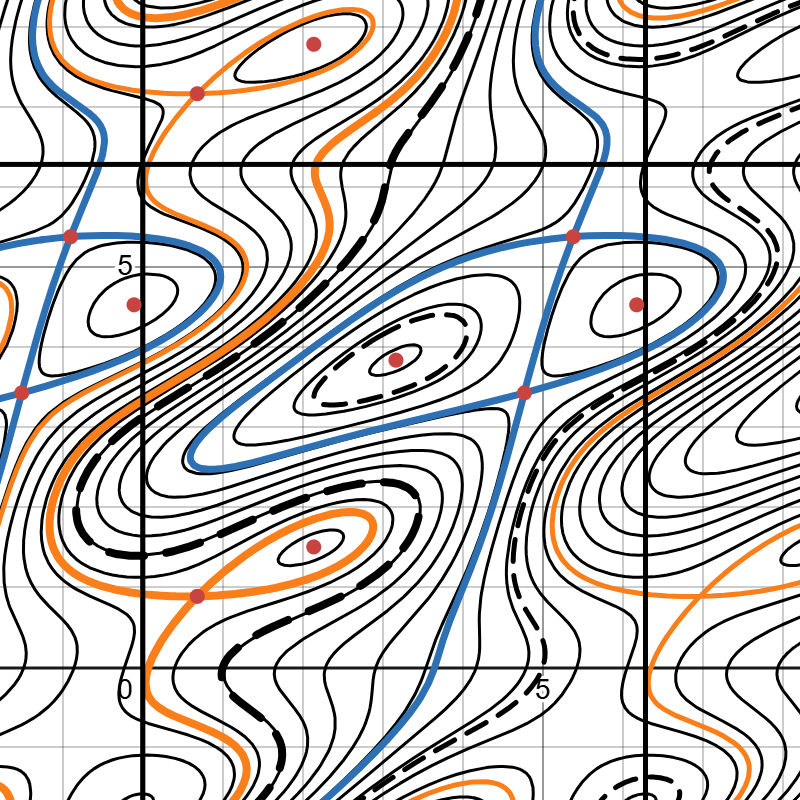
Figure 3: Level curves of uϕ,b,c,d (phase curves of the vector fields vϕ,b,c,d) for ϕ=1/3, c=1,b=2,d=1.0016. The black square has sides of length 2π. Separatrices of the saddles s1,s2,s3 are shown in thick. Thick dots represent singular points of vϕ,b,c,d. Dashed lines represent level curves uϕ,b,c,d=1,uϕ,b,c,d=5.

Clearly, the vector field vϕ,b,c,d is well-defined on the torus T2=(/2π)2. For simplicity of notation, we will lift it to the annulus 0y1. It is easy to check that for ϕ0, the vector field is transversal to y=0, y=1. Its phase curves are level curves of uϕ,b,c,d. Since uϕ,b,c,d(x,0)=x and uϕ,b,c,d(x,2π)=x2πϕ, the correspondence map from {y=0} to {y=1} is xx+2πϕ whenever defined.

Fig. 3 shows the level curves of uϕ,b,c,d for ϕ=1/3,b=2,c=1,d1. The following statements on vector fields vϕ,b,c,d were verified numerically for ϕ=1/3,b=2, c[0.7,1.1], d[0.9,1.3].

  • Vector fields vϕ,b,c,d have six singular points on the torus.

This was checked by applying Python’s fsolve method (that uses the Powell’s hybrid method) with the dense mesh of parameter values and initial guesses. Singular points are marked on Fig. 3.

  • These six singular points are hyperbolic; there are three saddle points, two minima of uϕ,b,c,d and one maximum of uϕ,b,c,d.

This was checked by computing the Jacobians of the linear part of vϕ,b,c,d. Jacobians remain greater than 2 in modulus.

Let s1,s2,s3 be the saddles of vϕ,b,c,d, numbered left to right in x-coordinate, x[0,2π].

  • The curves {y=0},{y=1}, the level curve {uϕ,b,c,d(x,y)=1,0<y<1}, and a connected component of the level curve {uϕ,b,c,d(x,y)=5,0<y<1} divide the torus into two domains V1 and V2; one of them (V1) contains s1 and a minimum of uϕ,b,c,d, the other (V2) contains s2,s3, and the remaining minimum and maximum of uϕ,b,c,d.

This was checked by (1) plotting these level curves for u1/3,2,1,1 (see Fig. 3) and (2) verifying that for all c[0.7,1.1], d[0.9,1.3], values of u1/3,2,c,d at its critical points in 0<y<1 are not equal to 1±2πk,5±2πk. This implies that critical points cannot move from one strip to another as parameters vary.

Since level curves of uϕ,b,c,d are phase curves for vϕ,b,c,d and uϕ,b,c,d(x,0)=x, we conclude that the correspondence map from {y=0} to {y=1} is defined near x=1,5. Consider the domain V1. Since uϕ,b,c,d is monotonic on y=0, out of four separatrices of s1, only one can intersect {y=0} and only one can intersect {y=1}. Since separatrices are the only obstruction from extending Poincare maps, exactly one separatrix must intersect {y=0} and one must intersect {y=1}. Thus the remaining two separatrices of s1 must form a separatrix loop in V1 as shown in Fig. 3, and the correspondence map from {y=0} to {y=1} in V1 is well-defined except a single point of intersection with a separatrix (to which it extends continuously).

Suppose that uϕ,b,c,d(s2)=uϕ,b,c,d(s3). Since uϕ,b,c,d is monotonic on y=0 and y=1, in the strip V2, only two of the eight separatrices of s2,s3 can intersect {y=0} and {y=1}. Since separatrices are the only obstruction from extending Poincare maps, exactly two of these separatrices intersect {y=0} and {y=1}. The remaining six separatrices must form three separatrix connections. There are two possibilities: we either have three separatrix connections between s2 and s3, or one connection and two separatrix loops. To check that we always have the first possibility as shown on Fig. 3, we verified the following.

  • The function uϕ,b,c,d is monotonic on the straight line segment joining the minimum and the maximum of uϕ,b,c,d in V2.

This was checked by computing the directional derivative of uϕ,b,c,d at the points of this segment, with step size equal to 0.01 of its length. If separatrices of s2,s3 formed separatrix loops, minimum and maximum of u would be inside these loops and the segment [s2,s3] would intersect the level set uϕ,b,c,d(x,y)=uϕ,b,c,d(s2) at least twice, which contradicts monotonicity of uϕ,b,c,d on [s2,s3]. Hence s2,s3 form three separatrix connections. The correspondence map from {y=0} to {y=1} is everywhere defined, except two intersection points with separatrices to which it extends continuously. Thus it coincides with xx+2πϕ as noted above.

We claim that the condition uϕ,b,c,d(s2)=uϕ,b,c,d(s3) defines a graph of an analytic function D=D(ϕ,b,c) in the parameter space for c[0.7,1.1], d2, ϕ1/3. This follows from the property below.

  • Derivative of uϕ,b,c,d(s3)uϕ,b,c,d(s2) with respect to d is positive for all c[0.7,1.1], d[0.9,1.3].

Derivative was computed via implicit function theorem. It remains between 2.05 and 2.15.

Hence for each c[0.7,1.1], the interval d[0.9,1.3] contains at most one value d such that uϕ,b,c,d(s2)=uϕ,b,c,d(s3). This value d=D(ϕ,b,c) was determined numerically for ϕ=1/3,b=2, c[0.7,1.1] and remains in [0.9,1.3]. Since the condition is open, the same holds for all b2, ϕ1/3, and D(ϕ,b,c) is well-defined. It is analytic since singular points of vϕ,b,c,d depend analytically on parameters.

For any vector field vϕ,b,c,D(ϕ,b,c), let U1 be the domain bounded by the separatrix connection of s1; let U2 be the domain bounded by the separatrix connections of s2,s3. Let stable separatrices of s1,s2 be γ1,γ2, let unstable separatrices of s1,s3 be Γ1,Γ2. Let ρ(ϕ,b,c)=uϕ,b,c,d(s2)uϕ,b,c,d(s1) be the distance between the intersection points of γ1 and γ2 with the meridian M0={y=0}. Numerically, we checked the following.

  • The value ρ(ϕ,b,c) is not constant on the graph (ϕ,b,c,D(ϕ,b,c)): namely, for c=0.7 we have d(c)1.23 and ρ3.40 while for c=1.1 we get d0.92 and ρ3.62.

The function ρ remains non-constant on c for ϕ1/3,d2 since it is analytic.

The remaining part of the proof is the same as for Theorem 10. While the vector field vϕ,b,c,D(ϕ,b,c) with ρ=ρ(ϕ,b,c) is not orbitally topologically equivalent to vρ,ϕ, the only difference is the explicit shape of the phase portrait inside U1,U2; the Poincare map and the behavior of separatrices γ1,γ2,Γ1,Γ2 is the same. Hence the proof of Lemma 13 applies to the family vϕ,b,c,D(ϕ,b,c) with ρ=ρ(ϕ,b,c), for any fixed b close to 2 and any fixed irrational ϕ close to 1/3, without any modification. In the proof of Lemma 12, we also used the fact that an orbital topological equivalence H matches corresponding saddles, H(sk)=s~k. For our family, the latter follows from the fact that s2,s3 form three separatrix connections while s1 has a separatrix loop. Hence the proof of Lemma 12 applies for the family vϕ,b,c,D(ϕ,b,c) with minor modification. These lemmas imply the second part of Theorem 17, which completes its proof. ∎

Acknowledgements

The work was partially conducted during the workshop “Interactions between Descriptive Set Theory and Smooth Dynamics” at BIRS (Banff), Spring 2022.

References

  • [1] H. Bruin and B. Vejnar. Classification of one dimensional dynamical systems by countable structures. Journal of Symbolic Logic, 88(2):562–578, 2023.
  • [2] J. Buzzi, N. Chandgotia, M. Foreman, S. Gao, F. García-Ramos, A. Gorodetski, F. L. Maitre, F. Rodríguez-Hertz, and M. Sabok. Open questions in descriptive set theory and dynamical systems, 2023. https://arxiv.org/pdf/2305.00248.
  • [3] A. Dzhalilov, I. Liousse, and D. Mayer. Singular measures of piecewise smooth circle homeomorphisms with two break points. Discrete and Continuous Dynamical Systems, 24(2):381–403, 2009.
  • [4] E. G. Effros. Polish transformation groups and classification problems. General Topology and Modern Analysis (Proc. Conf., Univ. California, Riverside, Calif., 1980), pages 217–227, 1981.
  • [5] M. Foreman. What is a Borel reduction? Notices Amer. Math. Soc., 65(10):1263–1268, 2018.
  • [6] M. Foreman and A. Gorodetski. Anti-classification results for smooth dynamical systems. Preliminary report, 2022. arXiv:2206.09322.
  • [7] M. Foreman, D. J. Rudolph, and B. Weiss. The conjugacy problem in ergodic theory. Annals of Mathematics, 173(3):1529–1586, 2011.
  • [8] M. Foreman and B. Weiss. Measure preserving diffeomorphisms of the torus are unclassifiable. Journal of the European Mathematical Society, 24(8):2605–2690, 2022.
  • [9] M. Gerber and P. Kunde. Non-classifiability of ergodic flows up to time change. Inventiones Mathematicae, pages 1–93, 2025.
  • [10] J. Glimm. Locally compact transformation groups. Trans. Amer. Math. Soc., 101(1):124–138, 1961.
  • [11] L. A. Harrington, A. S. Kechris, and A. Louveau. A Glimm-Effros dichotomy for Borel equivalence relations. J. Amer. Math. Soc., 3(4):903–928, 1990.
  • [12] Y. Ilyashenko, Y. Kudryashov, and I. Schurov. Global bifurcations in the two-sphere: a new perspective. Inventiones Mathematicae, 213:461 – 506, 2018.
  • [13] P. Kunde. There is no complete numerical invariant for smooth conjugacy of circle diffeomorphisms, 2022. arXiv:2209.02137.
  • [14] D. Ornstein. Bernoulli shifts with the same entropy are isomorphic. Advances in Mathematics, 4(3):337–352, 1970.
  • [15] M. Sabok. Completeness of the isomorphism problem for separable C*-algebras. Invent. math., 204:833–868, 2016.
  • [16] J. Zielinski. The complexity of the homeomorphism relation between compact metric spaces. Advances in Mathematics, 291:635–645, 2016.